Curriculum
Study Mode & Class Schedule

Study Mode: 15-month full-time
For single degree, students study both semester (Jan-Dec) in Hong Kong. Then complete a dissertation/project (Jan-Mar).
For double degree, students study in Hong Kong for Jan-May semester, then study in France for Sept-Dec semester. Then complete a dissertation/project (Jan-Mar).

Full-time
15 months
Assessment Methods
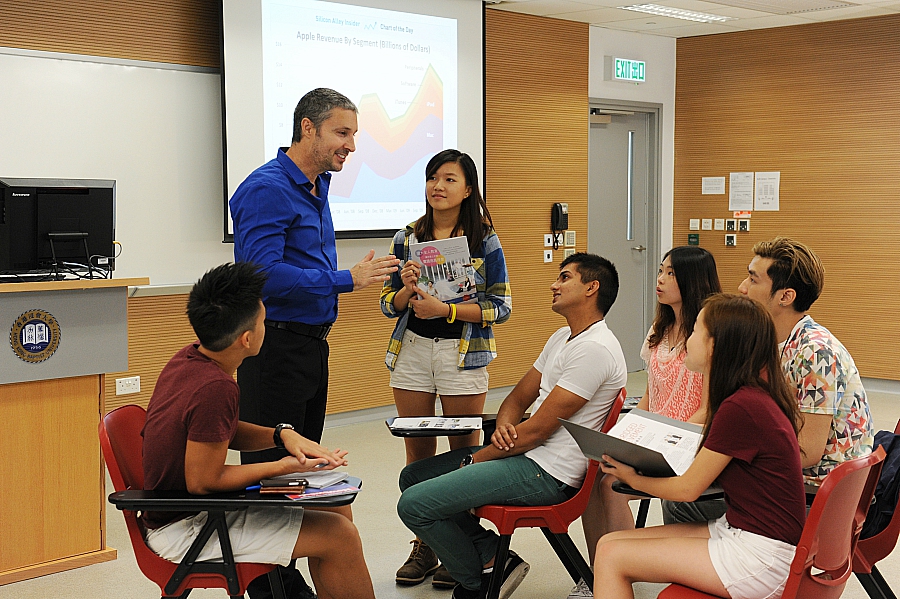
In addition to the final written examination, continuous coursework assessments including tests, quizzes, case studies, presentations, projects, and simulated exercises are used to optimise learning.
Curriculum Structure
The programme has 33 units of taught courses. The business project (or academic dissertation) accounts for 15 units. Students need a total of 48 units to graduate. For double degree, students must meet the requirements of both HKBU (including a minimum cumulative GPA of 2.5) and GEM in their respective semesters.
This course looks into the definition and myths of entrepreneurship and its importance in the economy including different characteristics of entrepreneurs and the opportunities in each entrepreneurial process. It will also examine effectuation, social entrepreneurship and corporate entrepreneurship.
This course provides hands-on experience to students and prepares them for building or working in startups (experiential entrepreneurship). One specific focus is to provide students with a foundational understanding of emerging technologies and concepts that are useful in startups as well as corporations, such as Artificial Intelligence (AI), Blockchain, Web3, and Decentralisation.
This course aims to provide a practical and current review of small and family business sectors by taking a diagnostic approach to the crafting of effective growth strategies. It allow students to “step into the shoes” of family and small business owner and/or managers to obtain a unique fast track learning experience in understanding the fundamentals and challenges in running and growing an existing company.
This course is an introduction to finance and accounting in an entrepreneurship environment. This module looks at the analysis of accounts and financial information from the point of view of the users (managers, entrepreneurs and investors) rather than the preparer (accountant) of information and emphasises the international dimension of financial reporting. It also presents the corporations’ financing cycle, the various resources used by corporations and the way investment and financing decisions are made.
This course is designed to help students get acquainted with some of the key techniques, frameworks and concepts relevant for strategic management. Many of these are used every day in the business world to help solve challenges businesses face. It deals with the core concepts and models affecting the process of strategy making of organizations and the way in which they can create value. This course will analyze the sources of competitive advantage, the strategic purpose of organizations, the content of business and corporate strategies, as well as various ways of cooperation, international expansion, and innovation.
This course focuses on the three major activities common to the marketing planning process across firms and industries: (1) analysis of market information, (2) development of brand and marketing strategy, (3) programming of the strategy and implementation of the marketing programs. It provides students with a background necessary for developing marketing plans; students tailor the course to their interests by their chosen project.
Social entrepreneurship embraces societal transformation and business innovation by seamlessly integrating financial returns with social impact. Successful social ventures are catalysts that fundamentally influenced how businesses can operate for as impact-driven business. This course blends classroom teaching with experiential learning for more meaningful connection with practice. On top of the theories and concepts, students will learn the essence of social entrepreneurship and the assessment of social impact through case studies, guest talks, and visits to social enterprises. .
This innovative and highly interactive course aims to provide students with a framework for conducting advanced effective sales negotiations by implementing proven methods and techniques. It is designed to enable students to understand how to build a relationship with their customers, to learn the value of engaging in questioning, and to develop listening and communication skills necessary to conduct successful sales negotiations.
This course focuses on the creation and management of entrepreneurial initiatives within corporate contexts. It covers the entrepreneurial imperative for corporations, the unique nature of corporate entrepreneurship, and different levels and forms of entrepreneurship in established organizations. The course explores fostering climates for internal corporate entrepreneurship and discusses venturing strategies, including the types of new businesses pursued and how they should be structured and managed for optimal performance. Additionally, it addresses the challenges of assessing entrepreneurial performance and the control mechanisms implemented by corporate managers to limit the autonomy of corporate entrepreneurial initiatives.
This course empowers students to evaluate leadership capabilities amidst different industry contexts with new perspectives. Students also have the chance to learn from industry leaders to discover how they navigate through uncertainties, changes, conflicts, risks and crisis with creativity and innovation. The course aims to prepare students to develop their preferred leadership strategy and style for future entrepreneurial ventures.
Digital Marketing and Inbound Marketing have surpassed Traditional Marketing due to widespread mobile internet penetration and the global popularity of social media. A significant portion of the world's population actively uses social media on mobile devices, with numerous social networks available. The continuous advancement of technology influences consumer behaviors both online and offline. Businesses are allocating more resources to digital marketing to reach their target customers. This course aims to equip learners with the knowledge and skills to develop innovative digital marketing strategies for organizations.
The course is specifically designed to prepare students for the challenge of globalization. This course provides students with knowledge and skills to undertake in-depth analysis on key issues of global marketing and theoretical grounding to face challenges in international markets and solve global marketing problems. Contemporary issues in global marketing will be discussed.
Business Project
The student must complete a 20,000-word Business Proposal (BP) as the culmination of their postgraduate program. The BP entails developing a new business start-up proposal, including Market, Product, and Benchmark Analysis. It should also provide a roadmap and action plan for decision-making and the introduction of the new business to the market. This project allows students to apply their acquired knowledge to a specific business problem in their field.
Academic Dissertation
This course requires the student to research a topic appropriate to the field of entrepreneurship and global marketing. The dissertation should involve engagement with theoretical concepts and practical application to an entrepreneurship and/or global marketing issue.
* Each course is worth 3 units, unless specifically stated.
# Curriculum pending final review and approval.
Graduation
The awarding of the MScEGM Degree is on the basis of fulfillment of the following graduation requirements and the approval of the Senate.
A candidate should have (double degree):
completed and passed all the 12 required core courses and an Academic Dissertation with a total of 48 HKBU units, and having met the requirements of both HKBU (including a minimum cumulative GPA of 2.5) and GEM in their respective semesters.
A candidate should have (single degree):
completed and passed all the 12 required core courses and a Business Project with a total of 48 HKBU units, and having met the requirements of HKBU (including a minimum cumulative GPA of 2.5).

Overall cumulative GPA of 3.67 or above, with no course grade below B- and no repeated courses.
.png "Acaedmic Merit (compressed)")
Overall cumulative GPA of 3.40-3.66